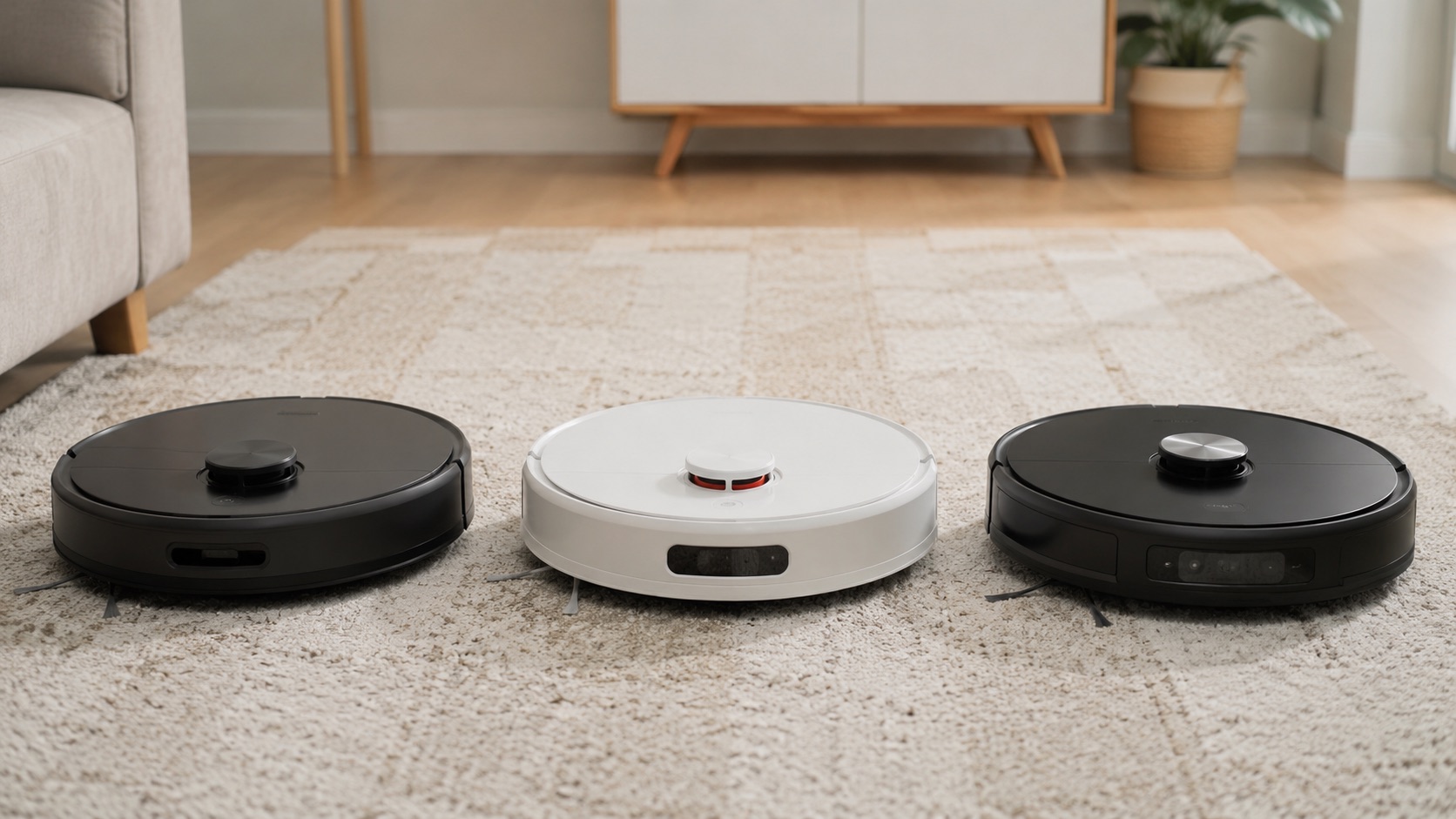
Best Robot Vacuums 2026: Researched Buyer Guide
Robot vacuums have gotten remarkably capable. The top models now vacuum, mop, empty their own dustbin, wash their mop pads, and use increasingly sophisticated obstacle avoidance. This research-based guide compares five models using published specifications, current feature sets, pricing checks, and long-term owner feedback. We have not hands-on tested every model in this ranking.
Use the robot vacuum topic archive for specialist guides on pet hair, mopping, large homes, brand comparisons and Home Assistant automation.
Short on time? Start with the Roborock S8 MaxV Ultra when it is meaningfully discounted. Always verify the live price before buying.
New models to watch, not automatic winners: Roborock introduced the Saros 20 Flow and Saros 20 Neo at IFA 2026. The Flow pairs Roborock-claimed 36,000 Pa suction and AdaptiLift Traverse 3.0 with a SpiraFlow 2.0 self-cleaning roller mop in an 8.98 cm body. The Neo uses a different warm-water mopping architecture and is positioned for 7.95 cm low-clearance access; do not transfer Flow test results to it. Regional listings are emerging, but availability and pricing vary, so neither replaces the established picks below without a local retail check.
COMPUTER BILD’s independent Saros 20 Flow test reported strong vacuuming, even and streak-free mopping, precise navigation and reliable obstacle avoidance in its test setup. Those are third-party findings for the Flow only—not HomeTechTested testing and not evidence for the Neo or every floorplan.
Quick Comparison Table
| Model | Price | Suction Power | Mopping | Self-Empty | Obstacle Avoidance | App Quality |
|---|---|---|---|---|---|---|
| Roborock S8 MaxV Ultra | Price varies by retailer | 10,000 Pa | Dual vibrating + lifting | Yes (dock washes & dries) | LiDAR + 3D structured light | Excellent |
| Roomba Combo j9+ | $240 to $360 | 5,000 Pa | Retractable pad | Yes (Clean Base) | PrecisionVision | Good |
| Roborock Qrevo CurvX | $900 | 12,000 Pa | Dual spinning + lifting | Yes (hot water wash) | LiDAR + RGB camera | Excellent |
| Ecovacs X2 Omni | $800 to $1,000 | 8,000 Pa | Dual rotating + hot water | Yes (hot air drying) | TrueDetect 3D 3.0 | Good |
| Dreame L20 Ultra | $700 to $900 | 7,000 Pa | Dual rotating + lifting | Yes (hot water + drying) | 3D structured light | Good |
Our Top Picks by Category
- Best Overall: Roborock S8 MaxV Ultra
- Best Budget: Roomba Combo j9+
- Best for Pet Hair: Roborock Qrevo CurvX
- Best Mopping: Ecovacs X2 Omni
- Best Value When Discounted: Roborock S8 MaxV Ultra
1. Roborock S8 MaxV Ultra, Best Overall & Best Value
Price: Check current retail pricing | Suction: 10,000 Pa | Mopping: Dual vibrating + auto-lift
The Roborock S8 MaxV Ultra combines a mature navigation platform, a self-maintaining dock, and a vibrating mop system. Its value depends heavily on the current retail price because discounts vary widely.
Roborock specifies a vibrating mop system and a 10mm mop lift for carpet transitions. The dock empties the dustbin, refills the water tank, washes the mop pads, and dries them. Actual stain removal and carpet protection depend on floor type, settings, and maintenance.
Navigation uses LiDAR combined with 3D structured-light sensing. Published features include multi-floor mapping, no-go zones, invisible walls, and room-specific schedules. Owner reports generally praise the navigation, but small cables and low objects can still challenge any robot vacuum.
For a deeper look at how Roborock stacks up against iRobot, check our Roborock vs Roomba 2026 comparison.
Pros:
- Strong value when meaningfully discounted
- Best-in-class vibrating mop system
- Excellent obstacle avoidance (rarely gets stuck)
- Full self-maintaining dock (empty, wash, dry, refill)
- Quiet operation at lower power settings
- Outstanding app with granular room controls
Cons:
- Retail pricing changes frequently
- Dock is large, needs dedicated floor space
- Vibrating mop less effective in corners than spinning mops
- Dustbin is on the smaller side for heavy shedders
2. Roomba Combo j9+, Best Budget Pick
Price: $240 to $360 | Suction: 5,000 Pa | Mopping: Retractable pad
iRobot may have lost the spec war, but the Roomba Combo j9+ remains a brilliant budget option. At $240 to $360 depending on sales, it offers self-emptying, mopping, and iRobot’s famously reliable navigation at a price that undercuts the competition significantly.
The unique retractable mop pad flips up onto the top of the robot when it detects carpet. Its published suction figure is lower than several newer rivals. Owner and editorial reports indicate adequate everyday pickup on hard floors and low-pile carpet, but that is not equivalent to our own controlled test.
The PrecisionVision system is designed to identify common obstacles, although independent reports describe less detailed navigation control than Roborock’s system. The Clean Base self-emptying dock is marketed for extended hands-off use, and iRobot’s app offers room-specific scheduling and cleaning preferences.
For households that want a set-it-and-forget-it robot without spending $800+, the j9+ is the one I recommend. It also integrates smoothly with Alexa and Google Home, see our best smart home ecosystem guide for setup tips.
Pros:
- Excellent price for a self-emptying combo vacuum/mop
- Retractable mop pad keeps carpets completely dry
- Reliable navigation with minimal stuck incidents
- 60-day self-empty capacity
- Strong brand with proven longevity
Cons:
- Lower suction power than competitors
- Mopping is basic, single pad, no scrubbing
- Dock doesn’t wash or dry the mop pad
- App can be slow to load maps
- Fewer customization options than Roborock
3. Roborock Qrevo CurvX, Best for Pet Hair
Price: ~$900 | Suction: 12,000 Pa | Mopping: Dual spinning + lifting
If you live with shedding pets, the Qrevo CurvX is the machine for the job. Its 12,000 Pa suction, the highest on this list, pulls embedded pet hair out of carpet fibers that lower-powered robots simply leave behind. The anti-tangle brush design means you’ll almost never need to cut hair off the roller, which is a genuine quality-of-life improvement for pet owners.
The CurvX name comes from its curved edge design, which is intended to improve cleaning along walls. We have not independently measured that advantage. Hot-water mop washing is designed to reduce residue and odor buildup compared with a cold rinse.
Navigation combines LiDAR and RGB-camera obstacle avoidance. The system is designed to identify common household and pet-related obstacles, although results depend on lighting and object size. Its larger dustbin may be useful in homes with heavy shedding.
Pros:
- Highest suction power (12,000 Pa), destroys pet hair
- Anti-tangle brush roll actually works
- Curved edge design improves wall cleaning
- Hot water mop washing eliminates odors
- Large dustbin for heavy debris loads
- Excellent app with pet-specific scheduling options
Cons:
- $900 is steep (rarely discounted as heavily as S8 MaxV Ultra)
- Spinning mops can leave swirl marks on some floors
- Slightly louder at max power than competitors
- Dock doesn’t dry mop pads as effectively as Ecovacs
4. Ecovacs X2 Omni, Best Mopping
Price: $800 to $1,000 | Suction: 8,000 Pa | Mopping: Dual rotating + hot water wash
The Ecovacs X2 Omni is the mopping champion. Its dual rotating mop pads spin at high RPM with consistent downward pressure, and the results on tile and hardwood are visibly better than vibrating or single-pad alternatives. It’s the closest I’ve seen a robot come to the results of a manual mop.
The square design helps it reach into corners, an area where round robots inevitably leave gaps. The dock washes pads with hot water and dries them with hot air, genuinely solving the mildew problem that plagued earlier generations. The auto-refill water system means it can mop large areas without running dry.
The TrueDetect 3D obstacle avoidance works well in most scenarios, though it occasionally gets confused by reflective surfaces based on available data. The YIKO voice assistant built into the robot is a nice touch for quick commands without opening the app.
Pros:
- Strong mopping specification and dock feature set
- Square design reaches corners better
- Hot water washing + hot air drying in dock
- 8,000 Pa suction handles most debris well
- Built-in voice assistant for quick commands
- Auto-refill water tank system
Cons:
- Square shape occasionally gets stuck in tight spaces
- TrueDetect can struggle with glass/reflective objects
- App less intuitive than Roborock’s
- Higher price for primarily a mopping advantage
- Some reports of edge brush wearing quickly
5. Dreame L20 Ultra, Honorable Mention
Price: $700 to $900 | Suction: 7,000 Pa | Mopping: Dual rotating + lifting
The Dreame L20 Ultra does everything well without being the absolute best at anything. Its mop extends beyond the robot’s chassis to clean along edges, a clever design that improves real-world performance. The 3D structured light obstacle avoidance is reliable, the hot water washing keeps pads fresh, and the mop lifts high enough to clear most carpet.
It sits in an awkward middle ground between the Roborock S8 MaxV Ultra’s value and the X2 Omni’s mopping prowess. If you find it on sale under $700, it becomes much more compelling. The app has improved significantly over the past year and now rivals Roborock’s for customization depth.
Pros:
- Extending mop reaches edges and baseboards
- High mop lift clearance for thick carpet
- Good all-around performance across all tasks
- Reliable obstacle avoidance
- Competitive app quality
Cons:
- Doesn’t excel in any single category
- Price is high for “good at everything” positioning
- Brand less established than Roborock or iRobot
- Dock is physically large
- Occasional wifi connectivity issues reported
What to Look for in a Robot Vacuum in 2026
Suction Power
Anything above 5,000 Pa handles hard floors easily. For carpet, especially with pets, aim for 8,000+ Pa. The difference between 5,000 and 10,000 Pa is noticeable on medium-pile carpet.
Obstacle Avoidance
LiDAR + camera combos are the gold standard. Pure LiDAR maps well but can’t see low-lying objects. Camera-based systems identify specific objects (shoes, cables, pet waste) and route around them. For homes with kids or pets, this is non-negotiable in 2026.
Mopping System
Vibrating mops scrub better for dried stains. Spinning mops cover more area and handle corners. Both work, the key differentiator is whether the dock washes and dries the pads automatically. Manual pad washing defeats the purpose of a hands-off robot.
Self-Maintaining Dock
The dock is arguably more important than the robot itself now. Look for: auto-empty dustbin, auto-refill water, hot water pad washing, and hot air drying. Skipping any of these means manual maintenance tasks you’ll eventually stop doing.
Smart Home Integration
All five models work with Alexa and Google Assistant for basic voice commands. If your smart home setup matters to you, check our guides on the best smart home ecosystem and best mesh wifi for smart homes, a solid wifi network is crucial for reliable robot vacuum operation.
Budget Considerations
Don’t just look at the sticker price. Factor in:
- Replacement parts: Brushes, filters, and mop pads need replacing every 3 to 6 months ($20 to $50 per set)
- Self-empty bags: $15 to $25 for a pack that lasts 2 to 3 months
- Cleaning solution: Some docks use proprietary fluid ($10 to $15/bottle)
Over two years, a $500 robot might actually cost $650 to $700 in total ownership. The Roomba j9+ has the cheapest consumables, while Roborock parts are readily available as third-party alternatives. For more smart home picks that won’t break the bank, see our best smart home devices under $50 roundup.
See how we compare products for our full methodology.
FAQ
How often should a robot vacuum run?
For most homes, running daily on a low-power setting works best. It prevents debris buildup and means the robot finishes faster with less noise. Homes with pets might benefit from twice-daily runs in high-traffic areas. All five models support room-specific scheduling so you can target kitchens and living areas more frequently.
Can robot vacuums fully replace manual vacuuming?
For 90% of households, yes. Modern robots with 8,000+ Pa suction and smart navigation cover floors thoroughly. You might still want a handheld or stick vacuum for stairs, upholstery, and tight spaces between furniture that robots can’t reach. But for regular floor maintenance, these robots handle it completely.
Are robot vacuums worth it for small apartments?
Absolutely, maybe even more so. In smaller spaces, robots finish quickly (15 to 25 minutes for a one-bedroom), and daily automated cleaning keeps tight spaces consistently clean. The Roomba Combo j9+ is particularly well-suited to smaller homes given its compact dock and lower price point.
How long do robot vacuums last?
Expect 3 to 5 years from a quality model with proper maintenance (regular brush/filter replacement, occasional sensor cleaning). Battery degradation is the usual lifespan limiter, most batteries maintain 80%+ capacity for 2 to 3 years of daily use. Roborock and iRobot both offer replacement batteries.
Is the Roborock S8 MaxV Ultra worth buying on sale?
It can be compelling when discounted well below its original launch price, but the exact value depends on the live price and newer alternatives. Compare the current price, warranty, consumable costs, and replacement-part availability rather than relying on an old sale figure.
For more robot vacuum comparisons, see our Ecovacs vs Roborock vs Dreame brand showdown, best robot vacuum for pet hair, and robot vacuum subscription plans compared guides.