Best Smart Home Devices for Google Home (2026)
Best Smart Home Devices for Google Home in 2026
Google Home has matured into one of the most capable smart home platforms available. With the redesigned Google Home app, Matter support, and deep integration with Nest products, building a Google-first smart home has never been easier or more rewarding.
But not all “Works with Google” devices are created equal. Some offer deep integration with Google Home routines, on-device controls, and presence sensing, while others barely go beyond basic voice commands. In this guide, we’ve curated the best devices in every category based on how well they actually work within the Google ecosystem — not just whether they technically connect.
If you’re still deciding between ecosystems, our best smart home ecosystem 2026 comparison can help you choose.
Top Picks at a Glance
| Category | Top Pick | Price | Google Integration | Alternative |
|---|---|---|---|---|
| Smart Display | Google Nest Hub (2nd Gen) | $99.99 | ★★★★★ Native | Nest Hub Max ($229) |
| Smart Speaker | Google Nest Audio | $79.99 | ★★★★★ Native | Nest Mini ($49) |
| Indoor Camera | Google Nest Cam (Indoor) | $99.99 | ★★★★★ Native | Aqara Camera Hub G3 ($109) |
| Video Doorbell | Google Nest Doorbell | $179.99 | ★★★★★ Native | Arlo Essential ($149) |
| Thermostat | Nest Learning Thermostat (4th Gen) | $279.99 | ★★★★★ Native | Ecobee Premium ($249) |
| Smart Lights | Nanoleaf Essentials A19 | $19.99 | ★★★★★ Matter | Philips Hue ($14.99+) |
| Smart Lock | Yale Assure Lock 2 | $219.99 | ★★★★☆ Matter | Nest x Yale ($249) |
| Smart Plug | Kasa KP125M (Matter) | $17.99 | ★★★★★ Matter | GE Cync ($24.99) |
| Sensors | Aqara Door/Window Sensor P2 | $19.99 | ★★★★☆ Matter | Eve Door and Window ($39) |
Smart Displays and Speakers
Google Nest Hub (2nd Gen) — $99.99
The Nest Hub is the control center of any Google Home setup. Its 7-inch display shows camera feeds, controls devices with touch, and serves as a hub for your routines. The 2nd Gen adds sleep sensing via Soli radar and improved audio. Every Google Home household should have at least one.
Why it excels in Google Home: It’s the native dashboard. You get device controls, camera feeds, routine triggers, and ambient mode — all deeply integrated in ways no third-party display can match. It also functions as a Thread border router, enabling local control of Matter devices.
Google Nest Audio — $79.99
For rooms where you don’t need a screen, the Nest Audio delivers excellent sound quality and full Google Assistant capabilities. Pair two for stereo. Voice recognition distinguishes household members for personalized responses and routines.
The Nest Audio is ideal for living rooms and bedrooms where you want great music playback alongside voice control. Its far-field microphones pick up commands reliably even while music is playing.
Cameras and Video Doorbells
Google Nest Cam (Indoor, Wired) — $99.99
The Nest Cam integrates seamlessly into the Google Home app. You get live view on any Nest Hub, person/package/vehicle detection, and activity zones. Clips appear directly in your Google Home timeline, and you can set automations based on camera events.
The wired version offers 24/7 recording with a Nest Aware subscription ($8/month), while the battery version records events only. For more camera options, see our Ring vs Arlo vs Eufy comparison.
Google Nest Doorbell (Battery) — $179.99
The Nest Doorbell announces visitors on every Nest speaker and display in your home, shows a live feed on your Nest Hub, and lets you respond via two-way audio from any device. Familiar face detection means your speakers can say “Sarah is at the front door” rather than just “Someone is at the door.”
The battery version installs without any wiring, making it perfect for renters or homes without existing doorbell wiring. For a broader look at smart doorbells, check our best video doorbells 2026 roundup.
Thermostat
Google Nest Learning Thermostat (4th Gen) — $279.99
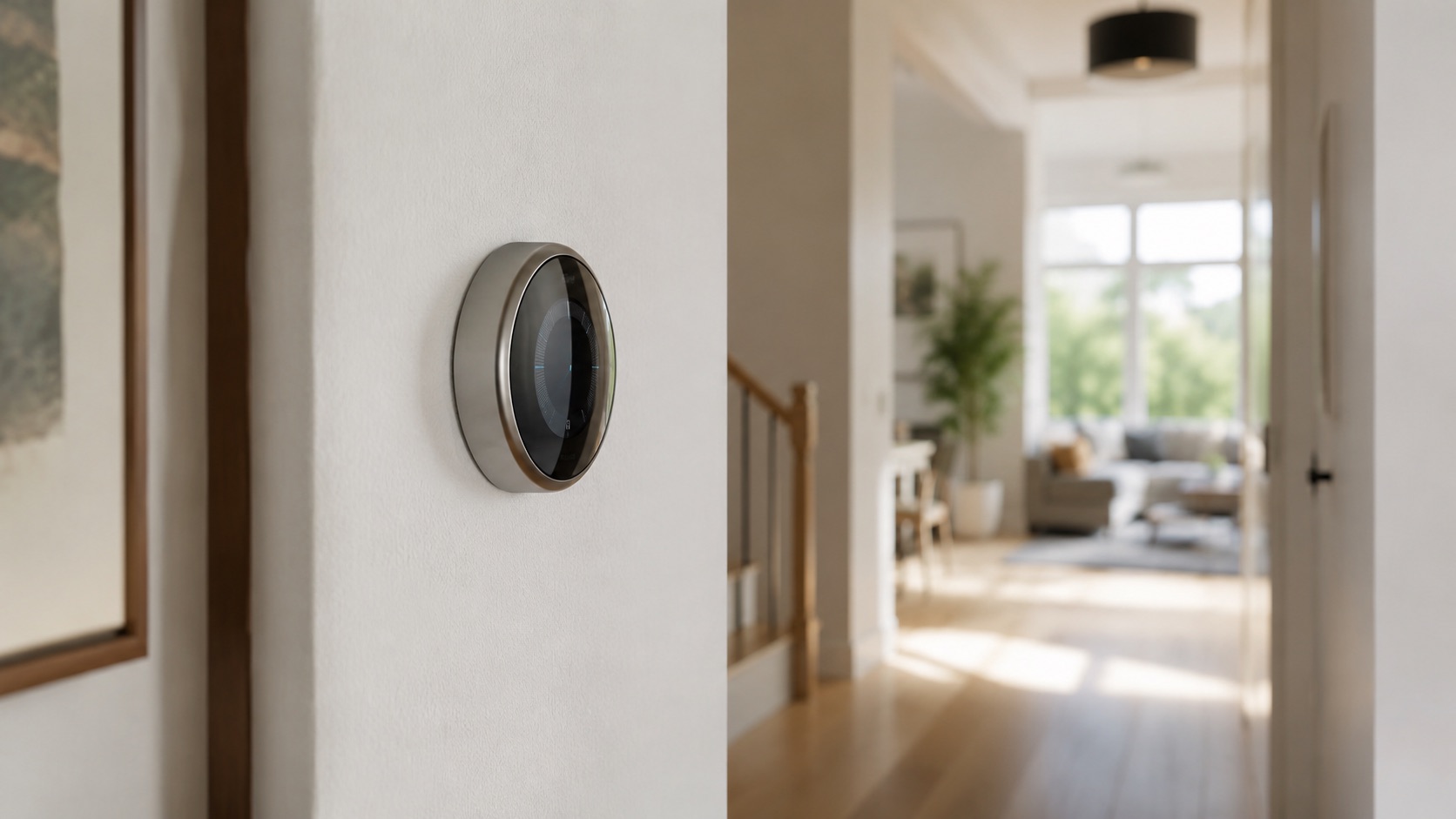
The latest Nest thermostat features a sleek redesigned display, improved learning algorithms, and deeper Google Home integration than ever. It uses your phone’s location for home/away sensing, integrates with Google Home routines, and shows energy reports directly in the app.
What makes it special in Google Home: The Nest thermostat uses Google’s presence sensing across all household members’ phones, making home/away detection far more accurate than any single-sensor solution. You can also include temperature adjustments in any routine — like setting eco mode when you say “Hey Google, goodnight.”
Budget alternative: The Nest Thermostat (basic, $129) offers Google integration without the learning features. See our full best smart thermostat 2026 guide for all options.
Smart Lights
Nanoleaf Essentials A19 — $19.99
Nanoleaf Essentials bulbs connect via Matter over Thread, giving you excellent responsiveness and local control through Google Home. They support full RGBW color, dimming, and color temperature — all controllable via voice, the Google Home app, or routines. No hub required.
Why Nanoleaf over Philips Hue: Nanoleaf uses Thread natively without requiring a bridge, is significantly cheaper per bulb, and offers equivalent Google Home integration via Matter. If you’re starting fresh in the Google ecosystem, Nanoleaf is the better value proposition.
Philips Hue — $14.99+ per bulb (hub required, $59.99)
Philips Hue remains the gold standard for smart lighting reliability. The Hue Bridge connects to Google Home and offers extremely fast response times and a massive accessory ecosystem. The downside is cost — you need the bridge plus bulbs, and premium bulbs run $40–60 each.
Hue makes sense if you want the widest range of form factors (light strips, outdoor fixtures, gradient bulbs) or already own the bridge. Its Entertainment mode for syncing lights with media also works exceptionally well.
Smart Locks
Yale Assure Lock 2 — $219.99
The Yale Assure Lock 2 with Matter support works natively in Google Home. You can lock/unlock via voice (“Hey Google, lock the front door”), check status in the app, and include lock actions in routines. It supports multiple access methods: keypad, fingerprint (Touch model), app, and key.
The Matter connectivity means fast local control without cloud latency. For a complete lock comparison, see our best smart locks 2026 guide.
Nest x Yale Lock — $249.99
The Nest x Yale was designed specifically for the Google ecosystem. It shows up natively in the Nest app and Google Home with no additional setup. It lacks a key slot (keypad only) and requires the Nest Connect bridge for remote access if you don’t have a Nest Hub nearby, but integration quality is flawless.
Choose Nest x Yale if you want the absolute tightest Google integration. Choose Yale Assure Lock 2 if you want Matter flexibility and a physical key backup.
Smart Plugs
Kasa KP125M (Matter) — $17.99
The Kasa KP125M connects via Matter and includes energy monitoring — a feature most smart plugs skip. In Google Home, you can voice-control connected devices, add plugs to routines, and check energy usage. Setup takes under a minute via Matter QR code.
Energy monitoring helps you identify power-hungry devices and automate them accordingly. This is especially useful for space heaters, fans, and appliances you want to schedule.
GE Cync Indoor Smart Plug — $24.99
GE Cync plugs work with Google Home via both direct cloud connection and Matter. They’re reliable and widely available. The slight premium over Kasa gets you a compact form factor that doesn’t block adjacent outlets.
Sensors
Aqara Door/Window Sensor P2 — $19.99
With Matter support, Aqara’s P2 sensors connect to Google Home and can trigger automations — turn on lights when a door opens, get notifications when a window is left open, or include sensor states in routines. You’ll need an Aqara hub (M3 or M2, around $59) to bridge sensors to Matter.
For a complete sensor roundup, visit our best smart sensors 2026 guide.
Understanding Google Integration Levels
Not all “Works with Google” devices provide the same experience. Here’s what separates great integration from mediocre:
Native (★★★★★): Appears in Google Home with full controls, supports routines as triggers and actions, shows in device dashboard, supports presence-based automation. Examples: All Nest/Google devices.
Matter (★★★★–★★★★★): Local control, fast response, works in routines, no cloud dependency. Examples: Nanoleaf, Yale, Kasa Matter plugs.
Cloud-to-cloud (★★★☆☆): Requires internet, slight delay, may lose features during outages. Works but not ideal for time-sensitive automations.
Basic voice only (★★☆☆☆): Can turn on/off via voice but no routine support, no dashboard presence, limited automations. Avoid these when better alternatives exist.
Matter and Thread: Why They Matter for Google Home
Google was an early and aggressive adopter of Matter, the universal smart home standard. In 2026, Google Home serves as both a Matter controller and a Thread border router (via Nest Hub 2nd Gen and Nest WiFi Pro).
This means:
- Matter devices work locally — no cloud delays, no outages
- Thread devices form a mesh — better range and reliability than Wi-Fi or Zigbee
- Cross-ecosystem compatibility — your Matter devices work with Google, Apple, and Amazon simultaneously
When choosing devices for Google Home, prioritize Matter-compatible options. They’ll be faster, more reliable, and future-proof. Our best Matter-compatible devices 2026 guide covers the full landscape.
Building Your Google Home Setup
If you’re starting from scratch, here’s the recommended build order:
- Start with a Nest Hub — it’s your control center, Thread border router, and shows you what’s happening
- Add lights — the most-used smart home feature and the fastest daily quality-of-life improvement
- Install a thermostat — the biggest energy savings and comfort improvement
- Add a doorbell camera — security with convenient visitor notifications
- Expand with locks, sensors, and plugs — automation building blocks for advanced routines
Our how to start a smart home from scratch guide walks through this process in detail, and our best smart home automations to set up first helps you get the most out of your devices once installed.
Total Budget: What to Expect
Here’s what a complete Google Home setup costs in 2026:
- Starter setup (display + 4 bulbs + 2 plugs): ~$220
- Core setup (above + thermostat + doorbell): ~$680
- Full home (above + lock + cameras + sensors): ~$1,200
Google Home doesn’t charge monthly fees for basic smart home control. You only pay subscriptions for Nest Aware camera recording ($8/month for one camera, $15/month for all cameras).
See how we compare products for our full methodology.
Frequently Asked Questions
Do I need a Google Nest Hub to use Google Home?
No — you can control your Google Home setup from any Android or iOS phone using the Google Home app. However, a Nest Hub acts as a Matter/Thread controller and provides a physical dashboard, making it the recommended starting point for any Google Home setup.
Does Google Home work with Matter devices from other brands?
Yes. Google Home is a fully certified Matter controller. Any device with the Matter logo will work in your Google Home setup regardless of brand. This includes devices originally designed for Apple HomeKit, Samsung SmartThings, or Amazon Alexa ecosystems.
Is Google Nest Aware required for cameras to work?
No. Nest cameras show live views and send motion alerts without a subscription. However, Nest Aware ($8–$15/month) is required for video recording history, familiar face detection, and extended event storage. Without it, you only see live feeds and basic notifications.
Can I use Google Home routines to automate everything?
Google Home routines support time-based triggers, device-state triggers (like a sensor opening), sunrise/sunset triggers, and presence-based triggers. You can control lights, plugs, locks, thermostats, and speakers as actions. Complex multi-condition logic is limited compared to Home Assistant but covers most common household scenarios effectively.
What’s the difference between “Works with Google” and native Nest devices?
“Works with Google” means a device connects to Google Home via cloud or Matter — it could be any brand. Native Nest devices are built by Google specifically for the ecosystem and receive the deepest integration, fastest updates, and most reliable performance. For most categories, Nest devices offer the best experience but third-party Matter devices come very close.